
Hunter New England Central Coast
primary health network
executive leadership team and OPERATIONAL management team
leadership program
OrganisationAL Profile
Hunter New England Central Coast Primary Health Network (HNECC PHN) is one of 31 PHN’s established by the Australian Government to increase the efficiency and effectiveness of primary health care services.
Covering a diverse region that spans urban, regional, and remote communities, from the Central Coast to the New England Tablelands, HNECC PHN works to improve health outcomes by supporting local health professionals and strengthening service integration.
With a strong focus on community needs, collaboration, and innovation, HNECC PHN partners with healthcare providers, community organisations, and all levels of government to deliver equitable, person-centred care across the region.
Its work is grounded in evidence, driven by data, and committed to ensuring all people have access to the right care, in the right place, at the right time.

PROGRAM OVERVIEW
HNECC PHN engaged the Australian Leadership Academy (ALA) to design and deliver a bespoke leadership program aimed at strengthening the cohesion, capability, and strategic impact of its Executive Leadership Team (ELT) and Operational Management Team (OMT).
Delivered in Newcastle and Tamworth, the longitudinal program focused on strengthening personal responsibility and accountability, embedding values-based leadership, and building a high-performing leadership team aligned around trust, healthy conflict, commitment, and collective results.
A defining feature of the program was ALA’s agenda-setting methodology, which enabled the ELT and OMT to surface their most critical adaptive challenges and strategic priorities. This ensured the program remained grounded in real-time organisational needs and directly supported future-focused leadership effectiveness.
Through high-impact facilitated workshops, peer discussion, and reflective practice, leaders deepened self-awareness, enhanced their capacity to lead through complexity, and established a collective leadership focus to sustain organisational performance and impact.
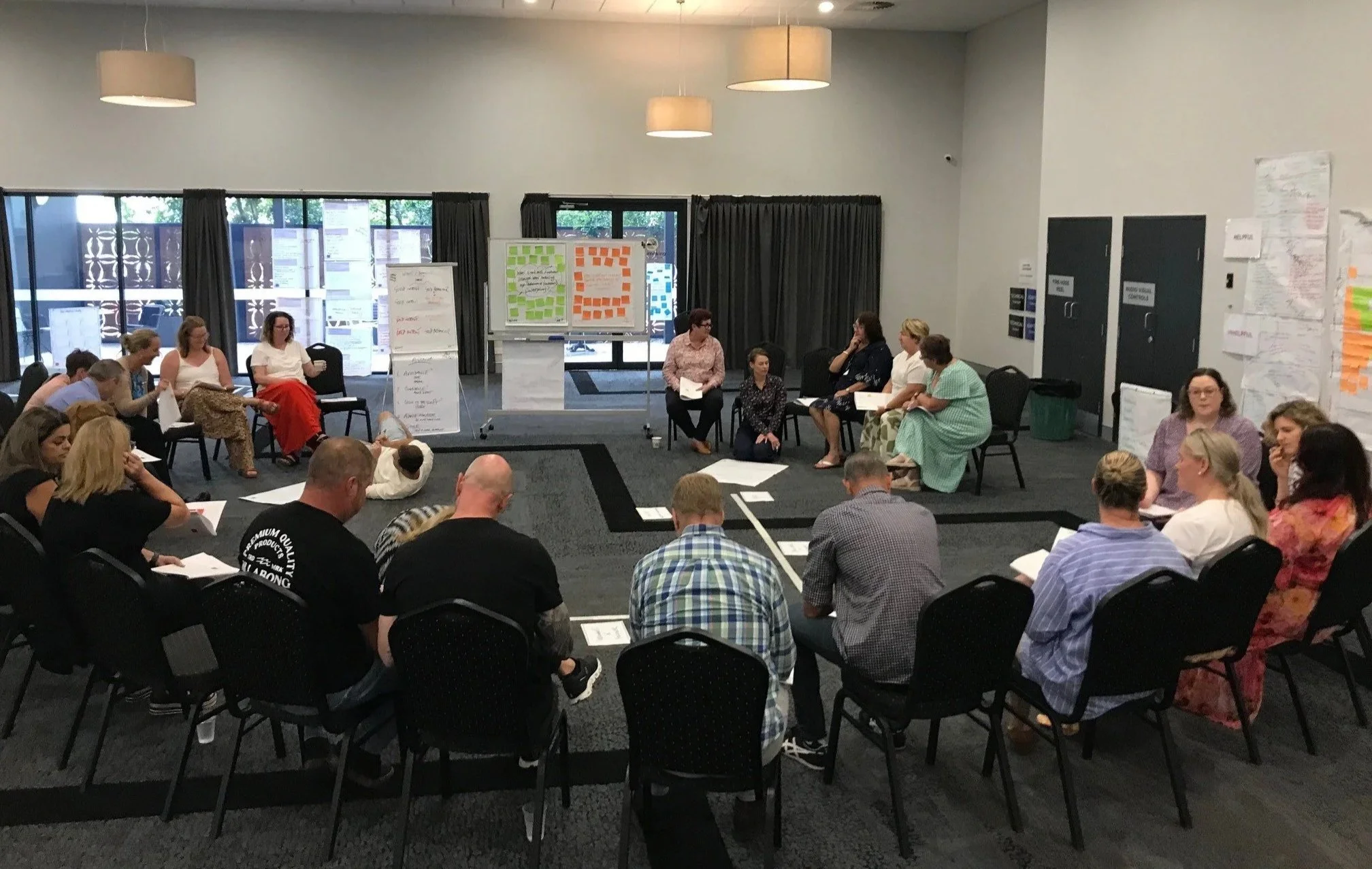
HNECC PHN Executive Leadership Team and
Operational Management Team
“Great program!
We are all on the same page
with a collectIve team vision.
loved the adaptive learning environment. Great opportunitY
for participation.”
Marilyn Dickson
Manager, Digital Health

“thank you so much…
The importance of observing team functions, ongoing leadership development, and engaging with our people at a transformational level.”
Steve Dye
Manager, Mental Health & Suicide Prevention

“Really loved the program,
great work!
The high-performance conversations framework and the different approaches have been incredibly valuable.”
Tom Synnott
Digital Technology Lead
“The program strengthened
our understanding of
adaptive leadership, reinforced our shared team vision, and highlighted the importance of
vulnerability-based trust.”
Cheyenne Moody
Rural Health Senior Project Officer
executive leadership team and
Operational management team
leadership program Feedback
ALA’s leadership program was
motivational and challenging?
97% strongly Agree
ALA’s approach supported the
needs of the ELT and OMT?
96% strongly Agree
The ELT and OMT actively
participated in the program?
95% strongly Agree
ALA’s leadership facilitator was
credible and effective?
100% strongly Agree
“love the way the facilitator put theory into practice”
Catherine Turner
Executive Manager, Commissioning

Program outcomes:
To what extent would you recommend the Australian Leadership Academy?
90% highly recommend
Leading with Personal Responsibility
Leaders strengthened their ability to take ownership of their leadership impact, demonstrating personal accountability and alignment with organisational values. They increased awareness of how their behaviour influences culture and performance.
Adaptive Leadership
Leaders developed the capability to distinguish between technical and adaptive challenges and apply appropriate leadership responses. They strengthened their capacity to navigate complexity, maintain productive tension, and mobilise others to address adaptive challenges.
High-Performing Teams and Team Culture
Leaders enhanced their understanding of the conditions required for high-performing teams, including a clear and shared team vision, trust, healthy conflict, commitment, and collective results. They reflected on their role in shaping a culture that supports collaboration, alignment, and shared ownership of outcomes.
High-Performance Conversations
Leaders built confidence and capability in leading purposeful, high-quality conversations. They strengthened their skills in providing clear and timely feedback and engaging in high-performance conversations to support accountability and learning across teams.
Leader as Coach
Leaders adopted a coaching mindset as a core leadership capability, embedding coaching approaches into everyday interactions. They increased their ability to develop others through effective questioning, feedback, and reflection, supporting capability growth, engagement, and sustainable performance.
“Highly valuable PROGRAM to foster deeper trust within the leadership TEAM”
Ali Koshel
Executive Manager,
Primary Care Workforce & Access
“Loved it!
The program reinforced the
importance of OUR shared VISION, TRUST,
and personal responsibilitY…
the foundations of strong, effective teams.”
Allison Leys
Manager, Primary Care Improvement Officer Team